The Science of Nasal Breathing
Why closing your mouth at night changes everything — from oxygen delivery to snoring to oral health. The research behind every design decision we make.
How Mouth Breathing Affects Your Sleep
Research shows that mouth breathing during sleep creates a cascade of disruptions. Here’s how the metrics compare.
| Metric | Mouth Breathing | Nasal Breathing |
|---|---|---|
| Airway Resistance | 2.5x higher[1] | Optimal baseline |
| Snoring Events | +4,500% increase[5] | Reduced 72% avg[8] |
| Snoring Volume | Severe disruption | Reduced 74%[8] |
| CPAP Nightly Usage | 30% adherence[6] | 71% adherence[6] |
| Nitric Oxide | Suppressed production | Full production[3] |
| CO₂/O₂ Exchange | Disrupted CO₂ balance | Balanced exchange[2] |
| Oral Microbiome | Dry, reduced protection[7] | Hydrated, protected[7] |
| Tidal Volume | Reduced[2] | Optimized[2] |
These differences compound over weeks and months. Mouth breathing contributes to sleep debt, reduced cognitive performance, and weakened recovery.
We Tested It. Here Are the Numbers.
50 participants. 90 nights. Diverse sleep profiles tracked with wearable devices. No cherry-picked results.
Six Benefits Backed by Research
Every design decision we make starts with the science. Here’s what the research shows about nasal breathing during sleep.
Nitric Oxide Production
Nasal breathing produces nitric oxide, which supports healthy airflow and oxygen delivery during sleep.
Source: Lundberg et al., 1995 [3]Optimized Airflow
Increases minute ventilation and tidal volume for efficient, unobstructed respiration throughout the night.
Source: ATS respiratory research [2]Snoring Reduction
Average 72% reduction in snoring frequency and 74% reduction in snoring volume across study participants.
Source: Sleepbiome validation study [8]CPAP Nightly Usage
CPAP nightly usage reaches 71% when combined with nasal breathing, compared to just 30% for mouth breathers.
Source: CPAP adherence research [6]Oral Health Protection
Maintains natural saliva levels, supporting oral moisture and reducing conditions associated with dry mouth.
Source: Oral microbiome research [7]Restorative Deep Sleep
Promotes longer, uninterrupted slow-wave sleep cycles where physical recovery and memory consolidation occur.
Source: Sleep architecture research [4]The Missing Piece in Your CPAP Therapy
Mouth breathing is the leading cause of CPAP air leaks, dry mouth during therapy, and ultimately, nights where the mask ends up on the nightstand. Research shows nasal breathing changes the equation.
- Fully compatible with nasal CPAP masks and nasal pillow masks
- Eliminates air leaks at the source by keeping your mouth sealed during therapy
- Allows your machine to maintain therapeutic pressure consistently
- Portable, silent, and non-invasive — no additional equipment needed
- 81% fewer snoring events over 90 nights of product testing
Finally Made My Machine Tolerable
I’ve used CPAP for three years and always woke up with a dry mouth and mask leaks. Adding Sleepbiome tape was the thing that finally made my machine work the way it was supposed to. My nightly usage went from about 4 hours to the full night.
8 million CPAP users in the United States. For many, mouth tape is the single most impactful addition to their therapy.
Try It With Your CPAPLip Health & Overnight Hydration
Mouth breathing dries your lips significantly. Standard lip balm addresses the symptom. We address the root cause — and go further.
Every Sleepbiome strip includes a built-in moisturizing hydrogel patch infused with four active skincare ingredients. It sits directly over your lips while you sleep, actively hydrating and nourishing them for 6–8 hours. Think of it as an overnight lip mask built into your mouth tape.
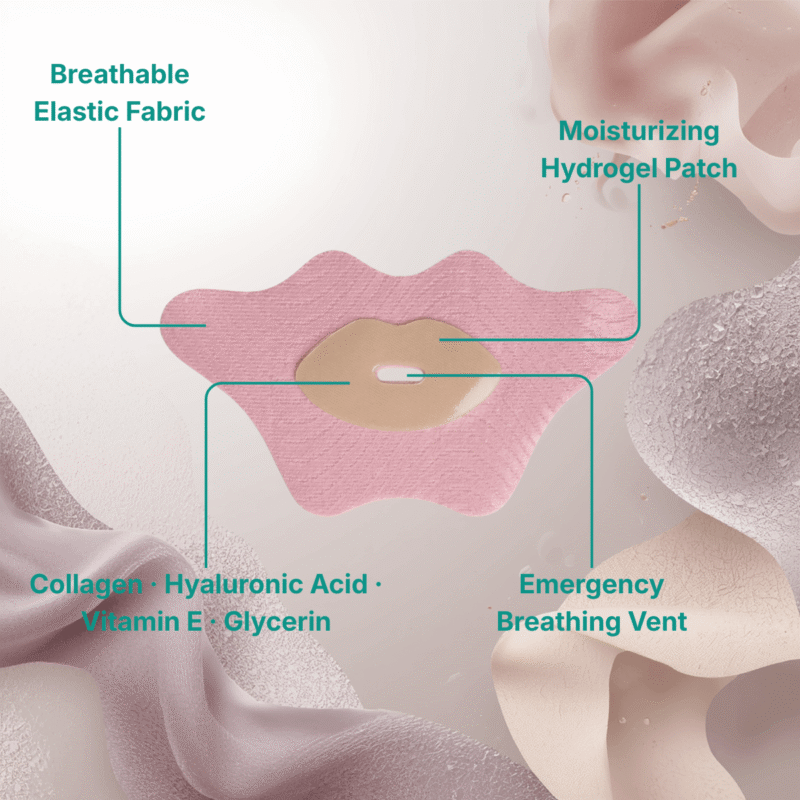
Nasal breathing optimization + active lip moisturization in a single strip. No extra steps. No competitor offers this.
Three Steps to Better Sleep
A precision-engineered sleep accessory — not a medical device. Your brain adjusts to nasal breathing within 1–2 weeks.
Peel & Apply
Clean, dry lips. Peel the strip from its backing. Place gently over closed lips. The silicone adhesive grips through stubble, moisture, and movement.
Sleep & Breathe
The “Goldilocks” adhesive holds all night while the hydrogel patch moisturizes your lips. The emergency breathing vent provides backup airflow for safety.
Wake & Remove
Painless removal. Zero residue. Softer, hydrated lips. Results compound — sleep quality continues improving with consistent use over weeks.
Ready to Sleep Better?
Every claim on this page is backed by research. The only thing left is to try it yourself.
Shop Sleepbiome LabsResearch Citations
- Upper airway resistance and nasal breathing mechanics — Rappai et al., 2003. Indian J Otolaryngol Head Neck Surg.
- Minute ventilation and tidal volume — CO₂/O₂ balance in respiration. Am Rev Respir Dis., 1985.
- Nitric oxide production and nasal breathing — Lundberg et al., 1995. Acta Physiol Scand.
- Slow-wave sleep and deep sleep restoration — sleep architecture recovery. J Clin Sleep Med.
- Nestor mouth breathing experiment — documented snoring increase (4,500%) and nasal breathing benefits. Breath, 2020.
- CPAP adherence and nasal breathing correlation — nightly usage improvement with nasal breathing vs. mouth breathing.
- Oral microbiome and saliva protection — mouth breathing drying vs. nasal breathing hydration.
- Snoring reduction research — Sleepbiome Labs validation study. 72% frequency reduction and 74% volume reduction with nasal breathing.